01
Dark Pool DEX
Your orders never sit on a public order book. Quote.Trade receives only what it needs to execute—not the strategy behind the trade.
 Connect wallet
Fully non-custodial AI-native dark pool DEX
Stream the all-in executable price for your actual size—including options. Execute privately across 1,500+ markets, including digital commodities, stocks, ETFs and indices, with OTC-grade liquidity, CEX-class performance, and publicly verifiable collateral.
Long SOL · 2× · $5,000Short BTC · 1× · $970,000Long ETH · 3× · $10,000Short DOGE · 2× · $2,500Long XRP · 2× · $7,500Short AVAX · 3× · $4,000Long LINK · 2× · $6,000Short SUI · 1× · $3,500Long AAVE · 2× · $420,000Short TON · 2× · $5,500Long ARB · 3× · $4,500Short PEPE · 1× · $1,500Long ADA · 2× · $9,000Short LTC · 2× · $6,500Long NEAR · 3× · $3,000
RoutingIllustrativeValidated in the workflow
“The integration took one evening—the fastest of five venues by a wide margin.”
“I can get the exact executable cost at my actual order size before I decide.”
Founder, autonomous quantitative trading system
One venue. Three strengths.
Quote.Trade combines fully non-custodial, publicly verifiable asset protection with large-size liquidity and 100k orders/s low latency—while execution remains private and strategy-blind.
Why trade on Quote.Trade?
Trade privately without broadcasting your orders or strategy. Positions and assets remain verifiable through permissionless smart contracts.
Your orders never sit on a public order book. Quote.Trade receives only what it needs to execute—not the strategy behind the trade.
Know your all-in cost before you trade. What you see is what you get—no trading fee is added afterward.
Use flexible leverage where enabled to express more market exposure with less committed capital.
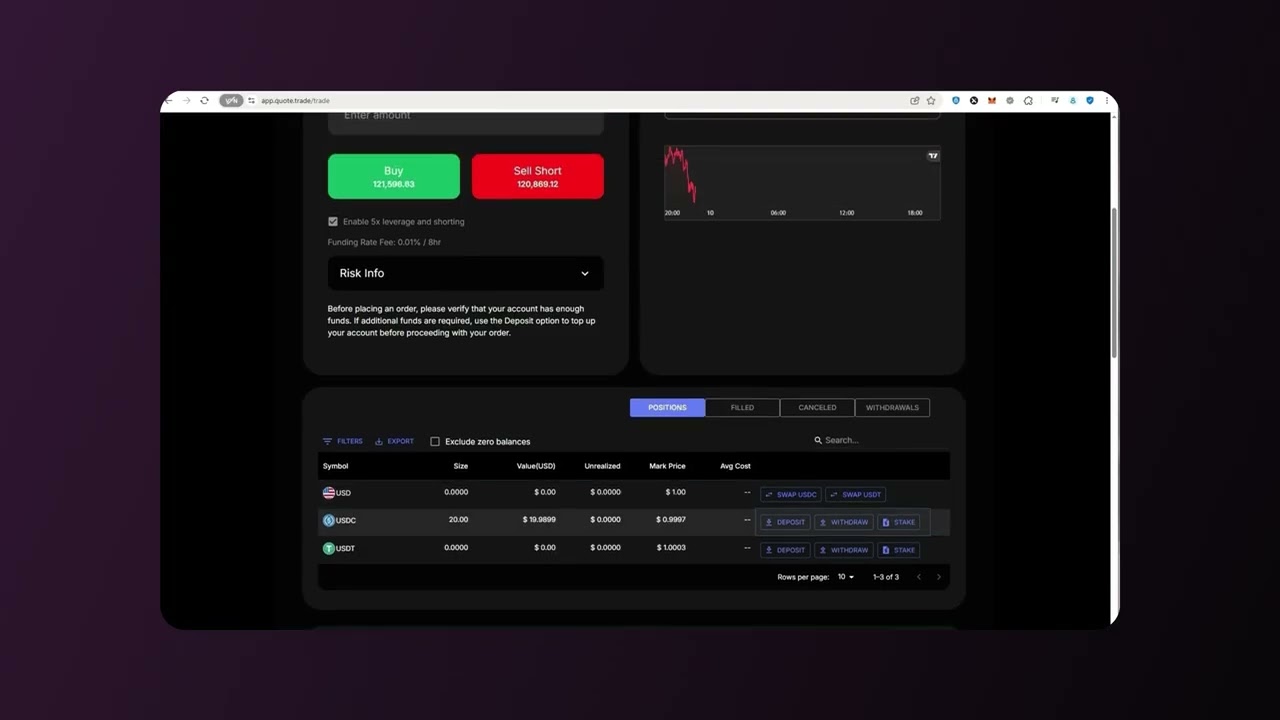
Fund once with a supported stablecoin, trade market exposure, and withdraw—without collecting every token.
Available liquidity is evaluated automatically to route your order to the best available quote.
Move between supported opportunities without bridging every underlying token or rebuilding your setup.
Trade your view in either direction instead of waiting for the market to cooperate.
Verify position state, funding, and withdrawal activity through public smart contracts.
Route to the best available liquidity and see a transparent, all-in cost before execution—even at sizes that may incur slippage on other venues.
Verify positions and assets in permissionless, non-upgradable smart contracts.
One account. Many markets.
Crypto trading should not begin with a chain map. Fund once with a supported stablecoin, then express a view across supported markets without acquiring and bridging every underlying asset.
Wallet → bridge → swap → approve → trade
Fund → quote → position
How it works
Funding, execution, and position state each do one job—so the trading experience can stay fast while the important rails remain verifiable.
Deposit a supported stablecoin through an accepted funding path.
Submit through the app, API, bot, or agent. The dark-pool engine finds an available quote.
Position state is maintained through the on-chain layer; eligible withdrawals return through the funding layer.
◆ Execution blind to your strategy · no public order book exposure
More assets to trade
Crypto, stocks, ETFs and commodities—including 24/7 gold, silver, oil, copper, SPY, QQQ and more. More assets than many traditional platforms—without managing a wallet full of bridged tokens. New markets are added over time.
Browse active markets ↗Privacy and power combined
Quote.Trade receives the parameters needed to execute your order—not the reasoning, portfolio logic, or broader strategy behind it. The order is never published to a public order book.
Trade without long forms or onboarding friction—your wallet is your identity in the permissionless product.
Seamless access across Ethereum and other supported EVM chains without bridging every underlying market asset.
Agentic trading infrastructure
Use Binance-compatible interfaces to automate private execution across 1,500+ markets—with fast quotes, advanced order types, and no public order book exposure.
↗Build advanced strategies. Trade on the go with our stealth BOT—command the dark pool from your chat.
const order = {
  symbol: "SOLUSDC",
  side: "BUY",
  collateral: 5000,
  leverage: 2
};

const preview = await quote
  .orders.preview(order);

// guardrails before execution
assert(preview.fee === 0);
assert(preview.notional < limit);

await approve(preview);▌Questions, answered plainly
Quote.Trade combines on-chain funding and position state with off-chain execution. The details matter.
Quote.Trade is an AI-native crypto dark pool DEX for human traders, trading bots, and AI agents. Users fund and withdraw supported stablecoins through smart-contract funding layers, while position state is maintained through on-chain position contracts. Dark-pool matching, order execution, pricing, and risk controls operate through an off-chain execution engine.
Read the technical overview ↗Quote.Trade treats AI agents as first-class platform users. Agents can discover tools through MCP, retrieve market data through REST or WebSocket, use a public OpenAPI specification, inspect authorized account information, preview orders, and submit guarded trading workflows.
Quote.Trade also provides Hermes and OpenClaw skill resources, an agent discovery file, a verified public OpenAPI schema, a live Telegram bot, and open-source Telegram and command-line clients.
Explore Quote.Trade for AI agents ↗A crypto dark pool DEX is a trading venue where orders are not published to a public order book before execution. On Quote.Trade, the execution engine receives the order parameters required to trade but not the trader's broader strategy. Matching occurs through an off-chain dark-pool engine, while stablecoin funding, withdrawals, and position state are anchored to public smart contracts.
Dark-pool execution does not mean that the entire platform is anonymous, confidential, or fully on-chain.
Quote.Trade separates funding, execution, and position state across on-chain and off-chain layers.
No. Quote.Trade uses a hybrid on-chain and off-chain architecture. Stablecoin funding and withdrawals are handled through smart-contract funding paths, and position state is maintained through on-chain position contracts. Matching, order execution, pricing, margining, and risk controls operate off-chain.
Quote.Trade is therefore a hybrid dark pool DEX rather than a fully on-chain exchange.
Answers for traders who need to understand whether Quote.Trade is a swap, how collateral works, what markets are available, and what costs are shown before execution.
No. Quote.Trade is not a spot AMM swap like Uniswap. Quote.Trade supports trading long and short with leverage through a stablecoin-settled, collateral-based model.
Users do not swap one token for another through an on-chain liquidity pool. They trade supported market exposure through Quote.Trade's dark-pool execution model, with collateral, margin, risk, and position state handled across on-chain and off-chain layers.
Yes. Quote.Trade trading is collateral-based, not a simple token-for-token swap. Users fund their account with supported stablecoins before trading. That collateral supports long or short positions and determines available buying power, margin, withdrawal eligibility, and risk status.
Account and trading workflows expose margin-related fields such as initial margin, maintenance margin, margin balance, position margin, unrealized profit and loss, and wallet balance.
No. Users do not need to acquire and bridge every underlying crypto asset before trading a supported market. Quote.Trade uses a stablecoin-settled account model, so users fund with a supported stablecoin and trade positions linked to supported markets.
Quote.Trade is not a general-purpose bridge. Users may still need to move their stablecoin onto an accepted funding network before depositing.
Quote.Trade supports a broad range of crypto markets, with new markets added over time. The live trading interface and production market metadata are the sources of truth for currently active symbols, settlement currency, minimum order size, quantity precision, and leverage availability.
Browse active markets ↗Yes. Quote.Trade supports both long and short positions, with leverage of up to 5x where enabled. Leverage can amplify both gains and losses and may increase the risk of liquidation. Confirm the direction, size, price, and leverage setting before submitting every order.
Open the trading interface ↗Quote.Trade presents a size-aware all-in execution price. No separate trading commission is added after the quote. The standard pricing target scheduled for the week of August 31, 2026 is approximately 13 basis points from midpoint per side, with the live quote authoritative for each market and quantity.
Every supported asset and its trading specifications should be available through Quote.Trade's market metadata. Traders, bots, and agents should review symbol status, settlement currency, minimum order size, precision, leverage availability, and other market rules before opening a position.
View exchange information ↗The permissionless product uses smart-contract funding, on-chain position state, and off-chain dark-pool execution.
Permissionless Quote.Trade is the smart-contract-funded version of Quote.Trade. Users fund with supported stablecoins through the Ethereum or XDC funding layer, trade through Quote.Trade's dark-pool execution engine, and have position state maintained through the position layer.
Funding and withdrawal rails are anchored to public smart contracts, while order entry, matching, execution, pricing, and risk controls operate off-chain.
Supported stablecoin funding is handled through the Ethereum or XDC funding layer. The position contract is used for position state and withdrawal checks; it does not custody user assets.
The funding layer is the stablecoin custody-side rail and controlled withdrawal-release path, while the position layer records positions and supports withdrawal checks.
Permissionless Quote.Trade uses shared funding contract infrastructure for supported stablecoin custody rather than deploying a separate custody contract for each user. User balances and withdrawal eligibility are tracked by account and checked against position-state data before release.
The position contract stores position records and is a non-custodial layer with no ERC-20 custody transfer path.
Contract payout certainty means eligible withdrawals follow a published funding and position-state control path rather than an opaque manual payout process. In the permissionless version, withdrawal requests are checked against position state and freshness controls before approved funds are released from the funding layer.
The payout path is structured around contract-held collateral, position-state checks, snapshot completeness, and controlled release logic. It is not a guarantee against trading losses, liquidation, ADL, market disruption, or smart-contract risk.
Funding, position state, and withdrawals are separated into different layers. Users fund with supported stablecoins through the smart-contract funding path. Orders are matched and risk-managed through the off-chain dark-pool engine. Position snapshots and related state are written to the position layer.
When a user requests a withdrawal, Quote.Trade checks current position state and freshness gates. If the request is eligible, approved funds are released through the smart-contract funding layer to the same account address.
In Permissionless Quote.Trade, payout confidence comes from the funding layer, position-state checks, snapshot freshness controls, and the withdrawal-release path. Users should be able to verify contract balances, position-state recency, and withdrawal status through public contract and explorer links.
In Quote.Trade Pro, payout confidence comes from the qualified-custodian account structure, contractual settlement terms, reconciliation procedures, margin rules, and reporting. The Pro version should not use the same proof language as the smart-contract-funded version.
The questions a serious security, trading, or risk reviewer will ask before trusting a hybrid exchange model.
Quote.Trade uses aggregated prices from major exchanges as real-time price references for mark prices. Quote.Trade does not set asset prices on its own.
Price references are published with a hash so historical price data can be checked for tampering. This is a price-publication and integrity model; it should be described separately from any public oracle contract if one is not being used.
Quote.Trade funding rates are fixed at 0.01% every 8 hours. Because the rate is fixed rather than dynamically adjusted by discretion, the funding-rate value itself is not an operator-selected variable from trade to trade.
Traders, bots, and agents should still review the current funding terms before holding leveraged positions.
ADL means auto-deleveraging. It is an emergency risk-control mechanism that can reduce or close positions when ordinary margin, liquidation, and collateral controls are insufficient to keep the market balanced.
If ADL is triggered, positions may be reduced according to a published priority methodology and executed as an automatic trade.
Quote.Trade's risk controls should be evaluated through published inputs, proofs, fixed rules, and account-risk logic rather than trust in a marketing claim. Price references are published with proof and can be compared to other markets. Funding rates are fixed. Liquidations and ADL follow automated rules based on account margin and risk.
For institutional review, the strongest supporting materials are public price-reference history, funding-rate rules, liquidation methodology, ADL methodology, and auditable risk-event records.
The current verification model is based on published position state, public contract balances, and real-time reconciliation against funded assets—not a broad zero-knowledge proof claim.
Users can verify public smart-contract addresses, funding contracts, position contracts, and relevant on-chain activity through the explorer links provided on the homepage. These links support review of the public funding and position-state layers.
The footer links to smart-contract explorers for position and funding contracts, along with the smart-contract audit and technical overview.
Quote.Trade published a V6 public-scope smart-contract audit dated August 20, 2026. The review covered the V6 Ethereum and XDC funding contracts, the constrained V1 fallback/hotwallet path, and the Polygon and XDC position layer. It reported no critical, high, or medium code-level findings within the reviewed public scope.
Private code, infrastructure penetration testing, signer custody, formal proofs, legal attestations, financial audits, and proprietary offline-engine verification were outside the review.
Read the V6 smart-contract audit and scope ↗Users trust Quote.Trade's off-chain node for order execution, liquidation, ADL if applicable, and operational risk controls. The execution engine receives order parameters but not the trader's broader strategy. The on-chain contracts support funding, withdrawal release, and position-state checks.
Pro is the permissioned version for approved institutional and professional users that need a custody model different from smart-contract funding.
Quote.Trade Pro is the permissioned version of Quote.Trade for institutions, eligible professional users, and approved counterparties. Instead of funding through the public smart-contract custody path, Pro users fund through a qualified custodian or approved custody arrangement.
The trading experience can still use Quote.Trade's dark-pool execution, pricing, risk, API, and agent infrastructure, while custody, onboarding, legal terms, and reporting are handled through the permissioned Pro model.
The major difference is custody and access. Permissionless Quote.Trade uses smart-contract funding and public on-chain position-state infrastructure. Quote.Trade Pro uses permissioned onboarding and qualified-custodian funding for approved users.
Use Permissionless Quote.Trade if you want smart-contract-funded access. Use Quote.Trade Pro if you need qualified-custodian funding, institutional onboarding, and professional reporting. Traders, bots, and agents can use either model if they meet the applicable access and permission requirements.
In Quote.Trade Pro, funds are held through a third-party qualified custodian rather than the public smart-contract funding path. Quote.Trade does not custody assets for Pro customers.
Pro users should review the applicable custody arrangement, settlement process, reconciliation cadence, authorization controls, and reporting terms before trading.
Yes. Quote.Trade Pro provides permissioned access to Quote.Trade's dark-pool execution and risk infrastructure. The custody path differs, but the product can still support long and short exposure, all-in quotes, APIs, bots, and AI-agent workflows.
Yes. Pro users trade against posted or allocated collateral. The difference is where that collateral is held and how it is reported.
In Permissionless Quote.Trade, collateral is funded through the smart-contract path. In Quote.Trade Pro, collateral is held or allocated through a qualified custodian or approved permissioned funding arrangement.
In Quote.Trade Pro, payout certainty is managed through qualified-custodian controls. The Pro proof model depends on custodian account structure, contractual settlement terms, reconciliation procedures, margin rules, and reporting rather than the public smart-contract funding path.
Yes. Quote.Trade Pro uses the same published pricing, funding, liquidation, and ADL methodology as Permissionless Quote.Trade. Where institutional documentation adds account-specific terms, those terms should be reviewed alongside the public methodology.
Pro and Permissionless have different risk models, not a simple more-secure or less-secure relationship. Permissionless gives users public smart-contract funding and on-chain position-state visibility. Pro gives approved users qualified-custodian funding, institutional onboarding, reporting, and contractual controls.
The right choice depends on the user's custody preference, legal requirements, operational needs, and risk policy.
Quote.Trade is an AI-native crypto dark-pool DEX for human traders, trading bots, and AI agents. It combines streaming quotes, private execution, stablecoin settlement, long and short market exposure, and verifiable on-chain position and asset infrastructure. The official Quote.Trade REST/WebSocket APIs remain the canonical integration surface for programmatic access.
Yes. Agents can read public market data, review account state, preview orders, and submit approved private IOC/FOK orders through scoped credentials and server-side controls. Production workflows display the exact symbol, side, quantity, all-in price, notional, leverage setting, and active limits before request-specific approval.
Yes. Agents can support withdrawals through Quote.Trade's scoped withdrawal workflow. The agent previews the exact asset and amount, displays the registered login wallet, obtains request-specific approval, submits with a withdrawal-enabled credential, and verifies the resulting account update and on-chain payment. The hosted MCP path fixes the destination to the user's registered login wallet.
Yes. Agents and bots can operate in both models with account-appropriate permissions. Permissionless agents can use public market data, account reads, guarded IOC/FOK orders, deposit-address discovery, and registered-wallet withdrawals. Pro agents can add institutional approval policies, account-level limits, custody workflows, settlement controls, reporting, and audit logs.
Public funding-contract balances show the supported stablecoins currently held by that contract at the selected block. Quote.Trade's private orders, fills, volume, routed liquidity, and hedging activity are measured through the execution and authenticated account layers. Quote.Trade Pro custody assets are measured through the applicable custodian records.
Quote.Trade combines V6 stablecoin balances and published user balances on Ethereum and XDC with PositionManager position and completed-snapshot state on Polygon and XDC. At a common completed snapshot, users can verify mappings, position state, funding transfers, published withdrawal balances, completed withdrawals, and aggregate collateral coverage.
The Polygon and XDC position snapshots reconcile against the balances published in V6, while those balances are compared with the actual USDC/USDT held in the Ethereum and XDC funding contracts. That provides a mathematical verification of the published balances and their collateral coverage while keeping individual trades, counterparties, routing, and volume private.
V6 is new because it is the new contract version. V6 is non-upgradeable, so new contract logic requires a new deployment and migration instead of modifying the existing contract in place.
V6 uses separate operational roles, a direct non-upgradeable core, registered-wallet settlement, three qualifying observations at least 22 hours apart, a shared historical cap, a post-publication cooldown, snapshot-completeness checks, replay prevention, physical-liquidity checks, exact transfer invariants, conditional velocity controls, timelocked membership changes, and emergency signer rotation.
V6 keeps every authorized operation inside the same contract-enforced rules. Balance publication and withdrawal execution use separate roles. Newly published balances require three qualifying observations at least 22 hours apart, completed multipart publication, the shared lowest-observation 1.5× cap, and a cooldown. Withdrawals settle only to the registered wallet and require a unique withdrawal ID, physical token liquidity, current signer epoch, and exact token-accounting checks. V6 is direct and non-upgradeable, composite changes are timelocked, and emergency mode rotates signer epochs and requires fresh observations.
For Ethereum-funded permissionless accounts, V6 Ethereum USDC/USDT assets and published account balances are aligned with the corresponding completed Polygon PositionManager snapshot. For XDC accounts, V6 XDC USDC assets and balances are aligned with the completed XDC PositionManager snapshot. Verification checks snapshot completion and freshness, wallet and user mappings, asset identifiers, scales, positions, synchronized marks, published balances, physical assets, and completed withdrawals.
Use the same size and synchronized market conditions. Compare Quote.Trade's size-specific FOK quote with the other venue's completed immediate taker execution. Record actual filled quantity, total amount paid or received, effective all-in execution price, taker fee, realized impact, residual quantity, and completion time.
How it works
Watch a quick overview, then explore step-by-step tutorials for funding, opening a position, and using advanced tools.
View tutorials ↗Stake for rewards
Choose a lockup period and earn a share of the available rewards pool.
Rates and reward availability can change. Review current staking terms in the app before committing assets.
The market is already moving
Private execution across 1,500+ markets, settled in stablecoins.
Get Live Streaming Quotes and Trade ↗